Written 2019, updated 2026
Written in 2019. Updated in 2026.
Read this first, a 2026 update. I no longer live in the neighborhood this story is about, and a few important things have changed since I did this in 2019:
- Schools no longer follow annexation. This is the big one. In 2021 Georgia passed SB 209, which broke the automatic link between a City of Atlanta annexation and the Atlanta Public Schools district. A home annexed into the city now stays in the DeKalb County School District unless it's moved separately by a local act of the legislature or an intergovernmental agreement between the two school systems. (When the change was challenged, the Georgia Supreme Court vacated the lower court's ruling in October 2025 without deciding whether the law itself is valid. The parents had sued the State, and the court held their real dispute was with APS, which is what denied the enrollment. So SB 209 stands and the constitutional question is still untested.) Either way, "better schools," which was a real draw for us in 2019, is no longer a reason to annex.
- The senior-tax gap has narrowed. Back then, DeKalb exempted seniors from the school portion of their taxes and Atlanta/APS didn't, which is why we stopped our boundary at one older neighbor's house. In November 2025 Atlanta voters approved a much better APS senior exemption, roughly 73% in favor: homeowners 65 and over can now deduct $50,000 from their assessed value on the APS portion, with no income test, replacing a $25,000 exemption that had strict income limits. That softens the warning considerably (though DeKalb's senior breaks are still generally more generous). Verify the current numbers.
- Taxes move every year. The specific millage rates and exemptions below are from 2019. Treat any dollar figure as illustrative, not current.
- The petition process itself is basically the same, the 60%/100% methods still govern, though there's more paperwork now (since 2022 the city has to file GIS data with the state). And the "Greenhaven" threat I mention has since stalled out.
Bottom line: this is how the process worked and felt, not current legal or tax advice. If you're actually doing this today, confirm the present-day rules with the City of Atlanta and DeKalb County first.
Introduction
So you want to get annexed into the City of Atlanta? Open up an Excel workbook, grab a clipboard, put on your walking shoes, and buckle up.
Back in 2019, a neighbor and I moved a group of 20 houses on our street into the City of Atlanta from unincorporated DeKalb. Afterward, enough people asked me how we pulled it off that I wrote the whole thing down. This is that guide: the entire process, plus the tips and the potholes.
It's not for the faint of heart. But I'd rather be long-winded and comprehensive than leave out the detail that trips you up.
Happy annexing.
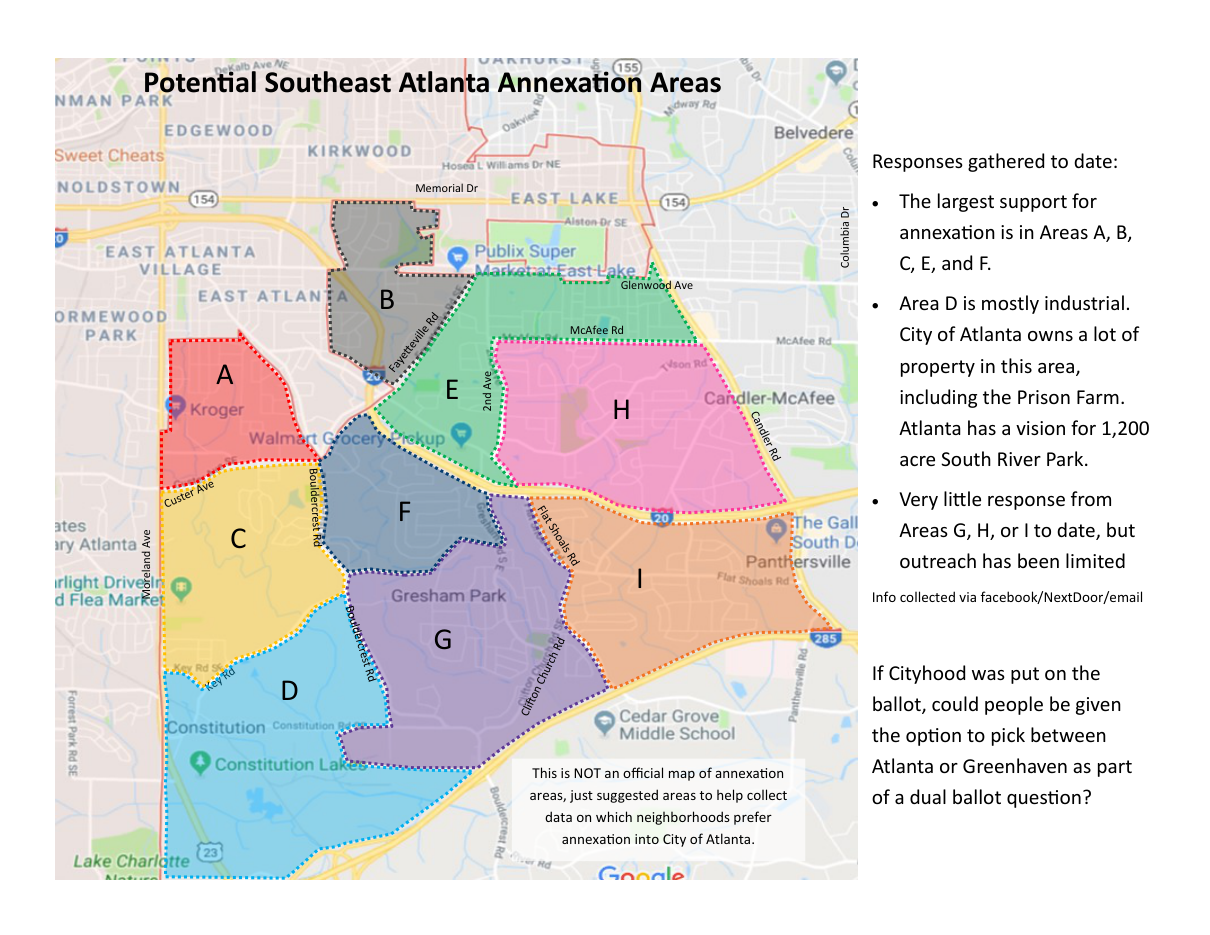
Why annexation can be attractive
There are real reasons to prefer being inside the City of Atlanta rather than unincorporated DeKalb. For us, back then, it came down to:
- Faster emergency response. Not waiting the better part of an hour for an ambulance. One neighbor spent three days trying to get DeKalb police to respond to a car break-in before being told, essentially, that no one was coming.
- Better basic services. The kind of thing where a pothole sits unfixed for the better part of a year.
- Higher property values. Hard to quantify, but homes on the city border tend to resell at a premium.
- Avoiding a worse outcome. At the time there was an active push to incorporate a new city ("Greenhaven") that would have swept the area in whether residents wanted it or not, and once you're in one city, you can't hop to another. Getting into Atlanta first took that risk off the table.
- Schools. (True in 2019; no longer, see the update at the top. New annexations stay in DeKalb schools.)
And then the surprise: taxes went down, not up.
Going in, I'd assumed City of Atlanta taxes were higher, and I told my neighbors to expect roughly $500 more a year. Almost everyone was in favor anyway. But when I actually asked the City's finance office to run comparisons for real houses on our street, every one of them came out lower inside the city, the savings ranged from a few hundred dollars to well over a thousand a year. The reason was timing: Atlanta had just raised the homestead exemption (from $20k to $50k) and carried a lower school millage rate, right as DeKalb raised property taxes. So "you'll probably save money" went onto the list of reasons, too.
With one important exception, which is its own section below.
The "60% method"
There are two ways in: the 100% method and the 60% method.
The 100% method is when every owner and registered voter in the proposed area signs. Because there's unanimous consent, it's the simpler, faster path, the city doesn't have to weigh competing interests. If it's just your house tacking onto the border, or you and a couple of neighbors, this is probably you.
Anything bigger, and you're doing the 60% method, which is what we used. It requires 60% of the owners and 60% of the registered voters in the proposed area to sign. You have to clear both bars. If you're an owner and a registered voter, your one signature counts toward both.
Here's how each bar is counted:
- 60% of registered voters: the city counts the registered voters whose address falls inside the proposed area, and its count is the one that counts. I had 34 on my spreadsheet. The DeKalb voter file came back with 38, and the Clerk's report of findings recorded 24 of our signers as exact name-and-address matches: 63.1%. Cleared, but with less room than I thought I had. (Track your own count as you go, then confirm it against the city's before you file.)
- 60% of owners: this one is weighted by land area, not by headcount. If one parcel is half the total acreage, that owner's signature counts for half the threshold. So a couple of big lots matter more than several small ones.
Splitting owners from voters seems odd until you picture a street of renters: if only owners could decide, the people actually living there would have no say, and vice versa. The two-bar rule makes sure both the people who own the land and the people who live on it are on board.
What to brace for
DeKalb doesn't want you to leave.
The county can't simply block a properly executed annexation, but Georgia law does give it a formal say: there's a notice-and-objection process, and unresolved disputes can go to arbitration. In practice, a clean petition sails through and a sloppy one hands the county an opening. The logic is a vicious cycle: annexation shrinks DeKalb's tax base, which strains services, which makes more people want to leave. There's also a long-standing détente, where the county won't actively fight annexations as long as the city doesn't actively recruit them, which is why Atlanta is happy to annex you but won't advertise it. The practical takeaway: don't give them a reason. Follow the process exactly so there's nothing to contest.
Some neighbors genuinely shouldn't do it.
I think being in the city beat being in unincorporated DeKalb, and about 95% of my neighbors agreed. But one group has a real, serious concern: senior citizens. At the time, DeKalb exempted qualifying seniors from the school portion of their property taxes and the City of Atlanta had no equivalent break, so for an older neighbor on a fixed income, annexation could have turned a modest tax bill into a much larger one, a potentially disastrous swing. (For most of the rest of us, taxes actually dropped.)
Be upfront about this. In our case, we simply stopped the boundary at his house so he wasn't affected. (Verify the current senior-exemption situation before assuming this still applies either way.)
It takes longer than you think.
Do everything perfectly and it's maybe three months. You won't, so plan on six.
Two timing traps:
- Taxes hinge on the calendar year. If a lower tax bill is part of the appeal, the annexation has to finish before the tax year starts, pass on February 1st and you still pay that year as if nothing changed. It takes effect the following January.
- City Council clears its slate every December. Anything not finished by December 31st gets thrown out, so a petition submitted in November likely won't even be introduced until January.
Here's how it actually unfolded for me:
- March 15, 2019, Two interested neighbors, a decision to go for it, and the paperwork begins.
- April 2, Start knocking on doors.
- April 8, Talked to 13 of 20 houses: 12 for, 1 against.
- April 25, 19 of 20 houses: 18 yes, 1 no. Visited the last house five times; no answer. Moving on.
- Early May, My son is born. Annexation takes a backseat.
- May 14, Petitions printed and dropped in mailboxes.
- May 18, A stray dog turns up in the street. Because I now have everyone's email, I can actually ask around. (Nobody knew him.) Small thing, but that's the point, you end up connected to your street.
- May 23, 10 of 18 petitions signed.
- June 22, 17 of 20 houses in. Waiting on two.
- July 3, Submit with the 17 I have, at the City Clerk's office.
- September 6, Rejected. One signature page was dated "6/20/2016" (a slip of the pen). Reprint, redistribute, re-sign.
- September 19, All petitions back. Repackage, resubmit at City Hall, and sit with the Clerk to check every page.
- October 15, Legislation drafted; to be introduced October 21.
- October 25, Letter confirming the petition met the criteria (60% of voters, 60% of owners by land area).
- October 26, "Proposed zoning change" signs go up in every yard.
- November 14, Zoning Review Board hears it. No vote at the first meeting, it's a public-comment step. Show up in person; if someone speaks against you, it can get tabled.
- November 20, NPU (Neighborhood Planning Unit) vote.
- November 25, Community Development / Human Services Committee review, the council committee that vets it before the full body.
- December 2, Full City Council vote, and it passes. Done.
Herding cats.
My favorite part was meeting everyone. It's one of the only times you have a real reason to knock on every door on your street. A few people invited me in for a beer, a couple became friends, and at minimum I now recognized the people I shared a neighborhood with.
But people have lives and their own stuff going on. Convincing ~40 people to sign a piece of paper, twice, was its own project. It took about half as long as the government approval itself and was at least as frustrating. Go in knowing that, stay calm, and carry on.
The steps, in order
- Figure out which houses to include
- Talk to your neighbors
- Get organized
- Get a map approved by the city
- Get warranty deeds for each house
- Collect petition signatures
- Prepare the petition
- Double-check everything
- File it
- Track it through the city
- Celebrate
1. Figure out which houses to include
My first instinct was to annex the whole four-block area, 300-ish houses. On reflection, organizing 300 households was a good way to fail, so I settled for my street: 20 houses. (If your property already touches the city line, annexing just your own may be an option, and a far simpler one.)
A few hard rules on what's even allowed:
- You must connect to the existing city boundary. You can't be an island. If you don't border the city, you have to build a chain of participating houses out to the line.
- You can't create an island of unincorporated land inside the annexation, either.
- There are limits on how much of the perimeter has to abut the city and on total land area relative to the connecting parcels. The city's map step (below) is what confirms you're within them.
2. Talk to your neighbors
The fun part. Once you have a rough boundary, go knock.
- Introduce yourself and say plainly what you're doing.
- Be ready to explain why annexation is worth it.
- Leave a one-page handout.
- Bring a neighbor along.
- Most important: write down every name, address, and email so you can follow up, and jot their reaction, which will range from "thank God someone's finally doing this" to "get off my lawn."
- Don't knock after dark. Be respectful; offer to come back.
You're not chasing a final answer, just planting the idea and getting contact info. It took me seven separate rounds to reach everyone (well, everyone but the one house that never opened the door).
Talking to people also settles your boundary: add houses where neighbors are keen, and just stop the line at the first house that's out.
Here's the kind of follow-up email I'd send:
Hey [neighbor],
Great to meet you last week. Wanted to follow up on the City of Atlanta annexation. We've now talked to most of the owners on the street and nearly everyone's in.
The short version of the benefits: faster emergency and city services, likely lower property taxes, and higher resale value.
The process is: we submit a petition, then City Council votes. We need 60% of owners and 60% of voters to sign, we're already over that, but I'm aiming for ~75% to be safe.
When you get a minute, let me know your thoughts.
Cheers, Jesse
3. Get organized
Build a spreadsheet and live in it. For each house I tracked: full address, emails, owner names exactly as they appear on the deed, whether I'd talked to them, whether they were in, number of owners, whether they'd signed, and whether I had their warranty deed. Let the sheet tally your percentages as you go.
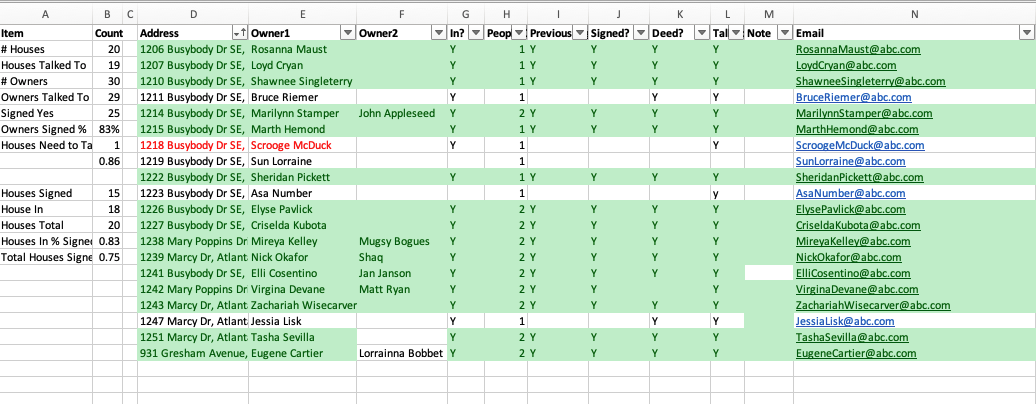
Get the owner names from the DeKalb County GIS parcel viewer, click any house and it shows the owners exactly as the deed lists them.
This matters more than it sounds: if your neighbor goes by "Kevin Smith" but the deed says "Kevin J. Smith," then "Kevin J. Smith" is what has to appear, printed and signed, on every document. Name mismatches get petitions thrown out.
Aim past the 60% bar, closer to 80%, to absorb the inevitable misspellings, missed voters, and dropouts.
4. Get a map approved by the city
Once you're confident you can clear 60%, ask the city for an official city-drawn annexation map. It both confirms your area meets the requirements (perimeter abutting the city line, land-area limits) and becomes part of your petition.
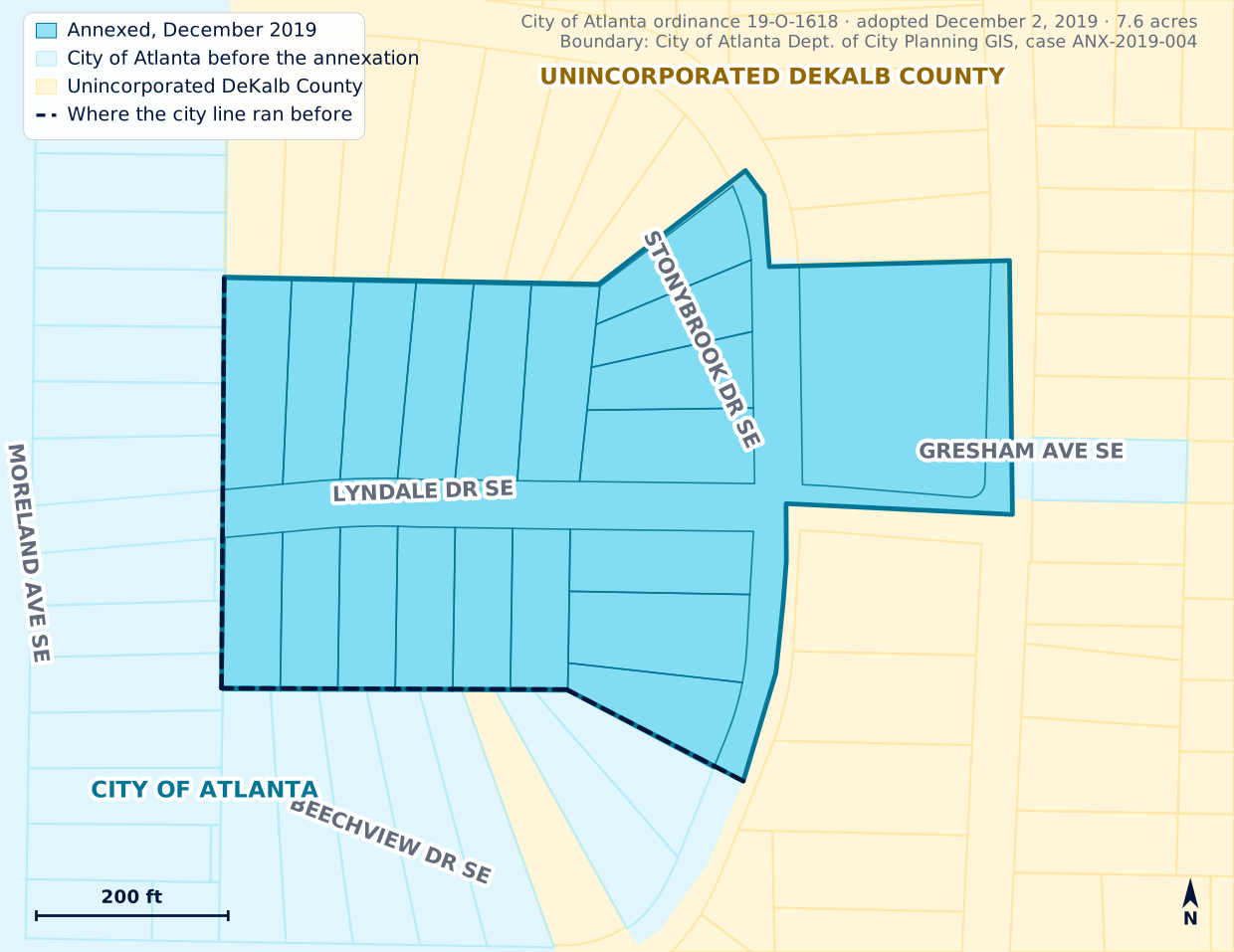
What we moved. The map filed with our petition isn't in the public record, the clerk's copy of the ordinance substitutes a page reading "LARGE ATTACHMENT(S) … NOT COPIED," so this is redrawn from the City of Atlanta's own GIS record of the annexation. The dashed edge is where we already touched Atlanta; everything else became new city line.
Contact the Mayor's office, say you're preparing an annexation petition, send the full address list, and ask for the map. (For what it's worth, every city employee I dealt with, the Mayor's office, the City Clerk, our future council rep, was professional, prompt, and genuinely helpful. Not what I expected, and a pleasant surprise.)
5. Get warranty deeds for each house
Collect a warranty deed for every signing house before you gather signatures, so you can match names exactly. A warranty deed is the document from when someone bought the house; it's the city's proof that a signer actually owns the property.
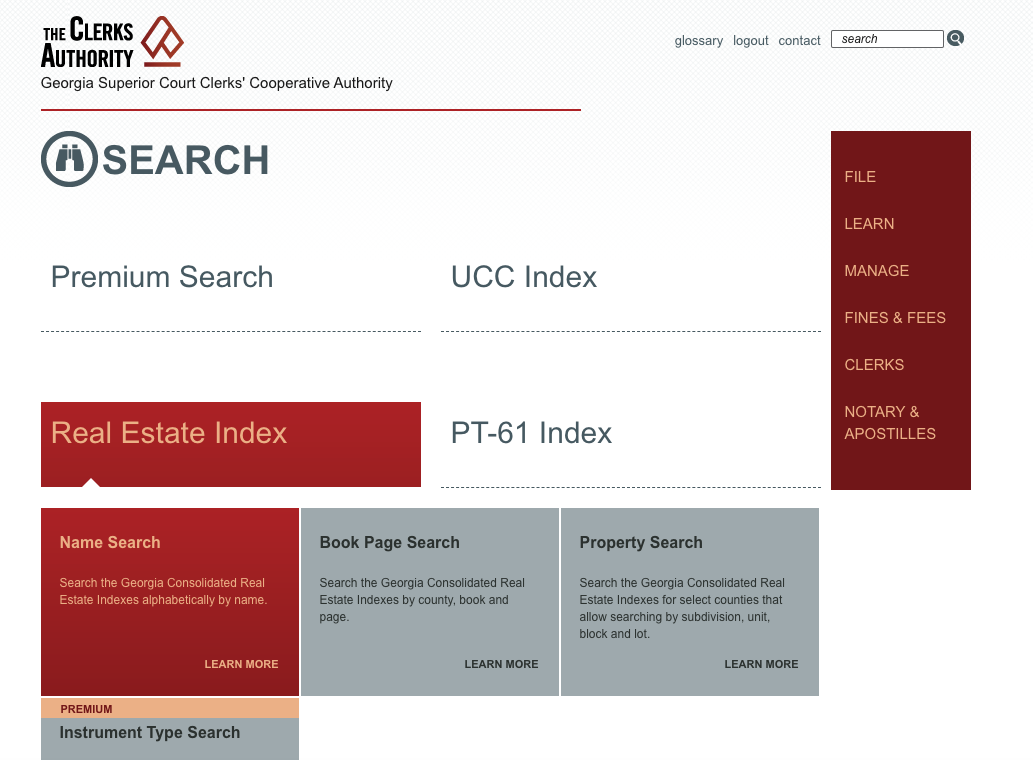
You pull these from GSCCCA.org:
- Create a single-use account (about $5 for 4 hours of access).
- Go to Real Estate Index → Name Search.
- For each property, search Last, First and filter by county (otherwise "Jesse Maddox" returns every Jesse Maddox in Georgia). Open the record for the address, view the image, confirm it's the Warranty Deed (or Security Deed), and save it as a PDF, about $0.50 per page.
Notes: sometimes a name search comes up empty, so try the co-owner's name; if you truly can't find one, email the homeowner and have them dig it out. And because the clock is a flat 4 hours, block off time to knock all of them out in one sitting. It's tedious and it costs a little money, but doing it yourself is far faster than waiting on 20 households to find a document most have never heard of.
6. Collect petition signatures
A petition needs signatures. With 18 houses, I gave each house its own page so I could collect them in parallel and one coffee spill wouldn't sink the batch. The full petition letter goes on the cover page; each signature page just needs a simple line: "By signing this petition I am agreeing to be annexed into the City of Atlanta from DeKalb unincorporated."
Two things make or break it:
- You need 60% of registered voters AND 60% of owners.
- Names must match the deed / voter registration exactly. I emailed each neighbor the precise spelling to use.
The exact instructions I gave people for each signature:
- Printed name, legibly, EXACTLY as on the deed or voter registration. For example, if the deed lists an owner as "Jane A. Smith" even though she goes by "Jane Smith," then "Jane A. Smith" is what has to be written. Anything else doesn't count.
- Signature, exactly matching that name, not "J. Smith," not initials.
- The date. (See the September disaster below.)
- Full printed address.
- Check one box: Owner and Registered Voter / Registered Voter Only / Owner Only.
7–8. Prepare it, then double-check everything
Your submitted package is: the petition letter, the annexation map, the signature pages, the warranty deeds for every signing house, and any extras (LLC authorization, death certificates, see the FAQ). The petition letter itself is short, it formally requests annexation under Georgia's 60% statute (O.C.G.A. § 36-36-31) and points to the attached signatures and boundary description.
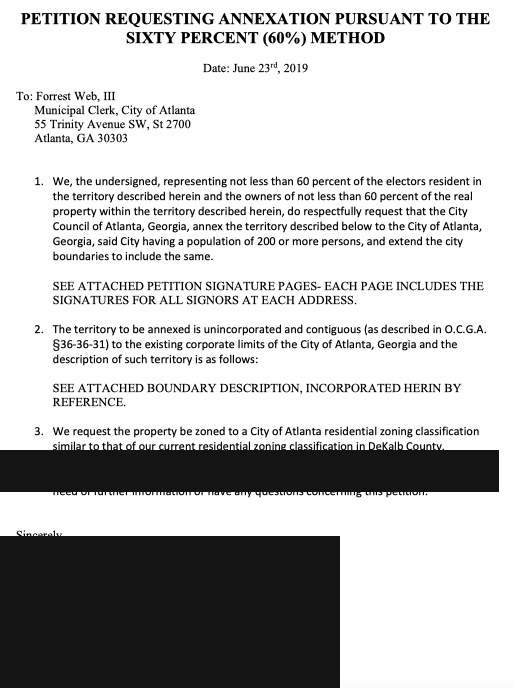
Then check it obsessively, because of what happened on September 6th.
The Clerk rejected the whole petition. One signature page had been dated "6/20/2016", a pen slip for 2019. The city's read of the law is that the earliest date anywhere in the packet is the start date, and all signatures must be within 12 months of filing. One stray "2016" invalidated everything. I spent half an hour on the phone with the Clerk working through all five stages of grief (I revisited anger a few times). There was no workaround: everyone had to re-sign, and they wouldn't hand the old petition back.
So: double-check every date, every name, every box before you file.
9–10. File it, then track it
Print it, take it to City Hall, and then follow it through the sequence: legislation drafted and introduced → a vetting letter confirming you met the thresholds → "proposed zoning change" yard signs → Zoning Review Board (public comment) → NPU vote → council committee → full City Council vote. Show up in person at the public meetings; a single opponent speaking can get you tabled and cost you weeks.
11. Celebrate
Sit back and smell the roses, you city slicker.
FAQ
A house is owned by an LLC. You'll need a document showing the signer has authority to sign for the LLC.
An owner is deceased. You'll likely need the death certificate plus documentation of who now has authority over the estate (an executor or heir), so the right person can sign in their place. This is where a quick call to the City Clerk, and possibly an estate attorney, saves you a rejected petition.
A house recently sold and the records haven't caught up. Use the new owners, as long as you can get the warranty deed showing they bought it, you're fine.
If you're actually attempting this today, start by confirming the current rules with the City of Atlanta and DeKalb County, annexation, school-district, and tax specifics have all shifted since 2019.