Build your board
Score projections under your rules, compare value over replacement and check format-appropriate draft position. Includes rookie boards.
Fantasy Football Toolkit · Free & open source
Draft boards, clear lineup plans and weekly briefs, built around your league’s actual rules.
I built this for my own personal use. Different scoring settings, flex slots and weekly decisions add up. I wanted a toolkit that would do the calculations and show its work.
Python terminal app · Sleeper & ESPN · No AI subscription needed
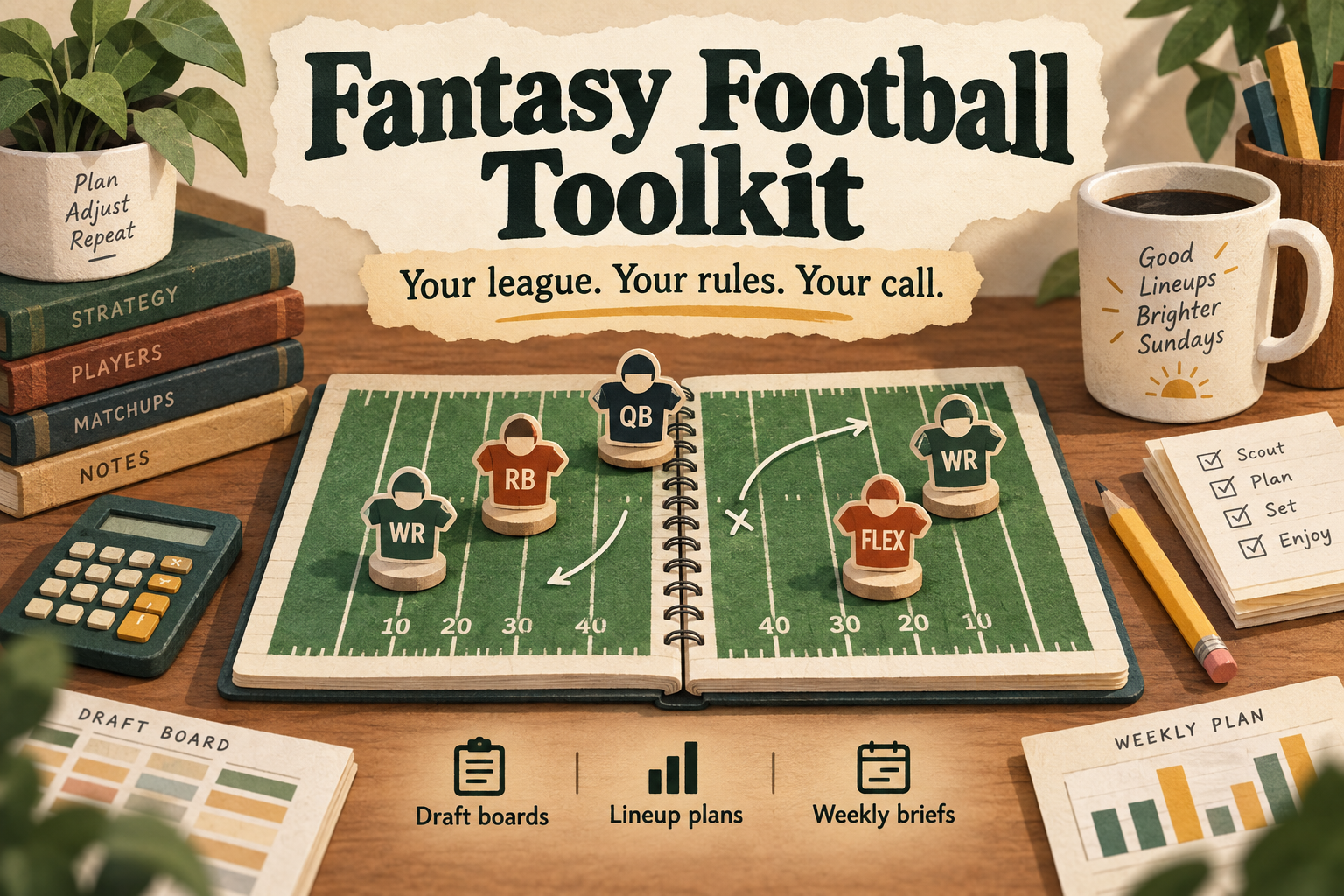
Score projections under your rules, compare value over replacement and check format-appropriate draft position. Includes rookie boards.
Solve the starting slots together, including flex and superflex. See who to bench, who to move and who to start, with kickoff locks respected.
Bring standings, injuries, upcoming byes, deadlines and lineup decisions into one brief. Dated consensus ranks add a separate reference.
An entirely invented example
The demo uses fictional players and made-up projections. Here, changing two starters raises its projected total from 47 to 67. You can see every assignment and check the reasoning.
Those are sample calculations, not a promise of better results. Projections are estimates; the final call stays with you.
Read the full terminal output →Demo League · Week 1
| Slot | Player | Projected |
|---|---|---|
| QB | Alex Quarterback | 18.0 |
| RB | Casey Runner | 16.0 |
| WR | Frankie Receiver | 22.0 |
| FLEX | Indigo Tight End | 11.0 |
The changes: Bench Harper Receiver and Gray Receiver. Start Frankie Receiver in WR and Indigo Tight End in FLEX.
Start with the demo
This is a small program you run in a terminal, a window where you paste commands. The setup guide walks through Windows, Mac and Linux. You don’t need Git, a GitHub account or a fantasy account to try it.
Built for me. Yours to adapt.
I’m sharing the complete reusable toolkit with invented examples in place of my league information. Feel free to improve mine, too. Hopefully it gives you a useful starting point, or at least a few ideas. Cheers!
The code is MIT licensed. Provider data has its own terms. This is an alpha personal project, and live integrations can change. It reads league information and prints suggestions; you make any roster changes yourself. Private league settings and credentials stay in your own local setup.